Take your first responsibility
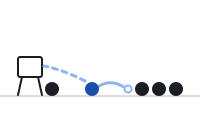
Where you are
You show up. You take part. People know your face. The next step up is small but real: holding one responsibility that people can count on. A job with your name on it.
What you're climbing to
The step you are climbing to means: "People can count on me." Not "I help sometimes". One named thing that happens because you own it: the kit, the welcome, the register, the music, the teas.
How to get a job with your name on it
1. Ask for it
Ask directly: a personal ask carries the strongest evidence there is at these first steps, and waiting to be noticed can take a long time. The ask is one sentence:
"I'm here most weeks anyway. Is there a job I could own?"
If they have nothing ready, offer one: "I could look after the kit. I'm always here early anyway." Small and specific beats grand and vague.
2. Know what "owning" means
Owning a job means it happens without anyone chasing you:
- You know what it needs before each session, and you do it.
- If you cannot make it, you tell someone early and sort cover: the job still happens.
- When something goes wrong, you flag it fast. Flagging early is doing the job well, not failing at it.
3. Reliability is a craft, not a personality
Nobody is born reliable. Reliable people run a simple loop:
- Write the promise down. Small promises evaporate unless they are written.
- Do it.
- Close it out loud. "Kit's sorted" in the group chat or at the door. The saying-so is part of the job: it is how the room learns to count on you.
Run that loop on small things, weekly, and you are building the exact muscle every rung above this one runs on.
4. One thing, done well
One responsibility owned properly beats three held loosely. If someone offers you a second job while the first is still wobbly, "not yet" is the reliable answer. Saying no to the second thing is part of being counted on for the first.
Practise this week
Fill in the blanks with real names and real days: a plan written in this shape is far more likely to happen than a good intention.
- Make the ask. When I next see (space to write in) (the person who runs things), I will say: "I'm here most weeks anyway. Is there a job I could own?"
- Run the promise loop once. This week I will write down one small promise ("I will (space to write in) by (space to write in)"), do it, and close it out loud with (space to write in).
- Set your cover plan. By (space to write in), I will agree with (space to write in) who covers my job if I ever cannot make it.
Pass it on
Know someone who is always there and ready for more? Send them this page with one line: the job you can see them owning. Then read the coach's page for this step (Hand someone their first responsibility): a role offered well lands differently from a rota gap being filled.
The best training for this step
Open the training shelf
These belong to their makers: we link and credit. Access and costs can change; checked 14 July 2026.
- Doit Life: search volunteer roles near you by cause. Browsing is free; applying may require an account and each role sets its own age limits.
- DofE: the volunteering section (free or low cost, via a school or centre, ages 14-24): a supported first volunteering role with a structure around it.
- Scouts and Girlguiding young-volunteer routes (Explorer Young Leaders, 13.5-18; Girlguiding young leaders, 14-17): a first owned responsibility inside a group that already knows you. Membership fees and local support vary, so check before you join.
The evidence
Open the evidence notes
- "Holds at least one responsibility, reliably" is this map's definition of the rung you are climbing to.
- Being given real responsibility, with room to do it your way, is how people step up.
- A personal, face-to-face ask carries the strongest evidence at the lower rungs; broadcasts mostly do not move people.
- Fill-in "when X, I will Y with Z" plans turn intentions into action far better than encouragement alone.
- Specific, small commitments beat vague offers to help.
- Honest boundary: reading this page does not make anyone count on you. You reach the rung when you hold at least one responsibility, reliably: that is the marker. The ask above, made to a real person, is how it starts.
Where next
- Handing this step to someone else? → hand someone their first responsibility (Hand someone their first responsibility)
- The rung you are climbing to → volunteer mastery (Volunteer: be the one they count on)
- The rung you are on → participant mastery (Participant: show up well)
- The best training for this step → the shelf above
Before you open anything else: make the ask from your practise list. One sentence, next time you are there.
Sources for this page
Named sources for the main research and guidance claims. Our rung definitions are our own framework.